

What Is a Centrifugal Vent Fan and How Does It Work?

A Centrifugal Vent Fan moves air through a practical combination of rotation, pressure, and controlled discharge. Its impeller pulls air into the center, then pushes it outward through curved blades. The housing converts that movement into useful static pressure. This design supports ducted ventilation, even when filters, bends, or long passages resist airflow. That difference matters.

The U.S. Environmental Protection Agency reports that indoor pollutant concentrations can be two to five times higher than outdoor levels, and occasionally much higher. Its report, The Inside Story: A Guide to Indoor Air Quality, connects effective ventilation with healthier indoor environments. A correctly selected Centrifugal Vent Fan can remove moisture, odors, smoke, and airborne contaminants from kitchens, bathrooms, workshops, and commercial spaces. Not every fan performs equally.

ASHRAE Standard 62.1 and Standard 62.2 provide widely recognized ventilation guidance for commercial and residential buildings. Their requirements emphasize outdoor-air delivery, contaminant control, and maintainable systems. AMCA publications also explain fan testing, system effects, pressure measurement, and efficiency evaluation. These references show why airflow alone cannot define performance. Static pressure, motor efficiency, sound level, and operating conditions must be considered together.

The U.S. Department of Energy’s fan-system guidance further highlights the importance of matching fan capacity with actual system resistance. Oversizing may increase noise and energy use. Undersizing may leave stale air behind. That sounds simple. It is not.

This guide explains how centrifugal fans work, how their components interact, and how to assess real-world performance. It also examines common selection mistakes, because specifications can look impressive while installation details quietly reduce results.
What Is a Centrifugal Vent Fan and How Does It Work?

Centrifugal Vent Fan: Definition and Core Purpose

Centrifugal Vent Fan: Definition and Core Purpose

A centrifugal vent fan is a mechanical device that moves air through a rotating impeller. Unlike an axial fan, it draws air into the center and pushes it outward at a right angle. This design creates stronger pressure, making the fan suitable for long ducts, filters, bends, and other airflow resistance.

Its core purpose is controlled air extraction or supply. In a kitchen, it can remove warm, greasy air through ductwork. In a workshop, it can carry dust-laden air toward a filtration system. In a bathroom, it helps reduce moisture before condensation damages walls, ceilings, or insulation. The fan housing guides the air smoothly toward the outlet.

The impeller speed affects airflow, pressure, noise, and energy use. A larger motor does not always provide better ventilation. The duct diameter, length, and number of bends must match the fan’s operating range. A poorly sized system may sound powerful but move little air. That is easy to overlook.

Installation details matter. Sealed joints prevent leakage, while a stable mounting surface limits vibration. A backdraft damper can reduce unwanted airflow when the fan stops. Regular cleaning also protects performance, especially where grease or fine particles collect. Yet maintenance intervals should reflect actual conditions, not a convenient guess. Reliable results come from measuring airflow and static pressure after installation.


Main Components and Their Roles in Air Movement

What Is a Centrifugal Vent Fan and How Does It Work?

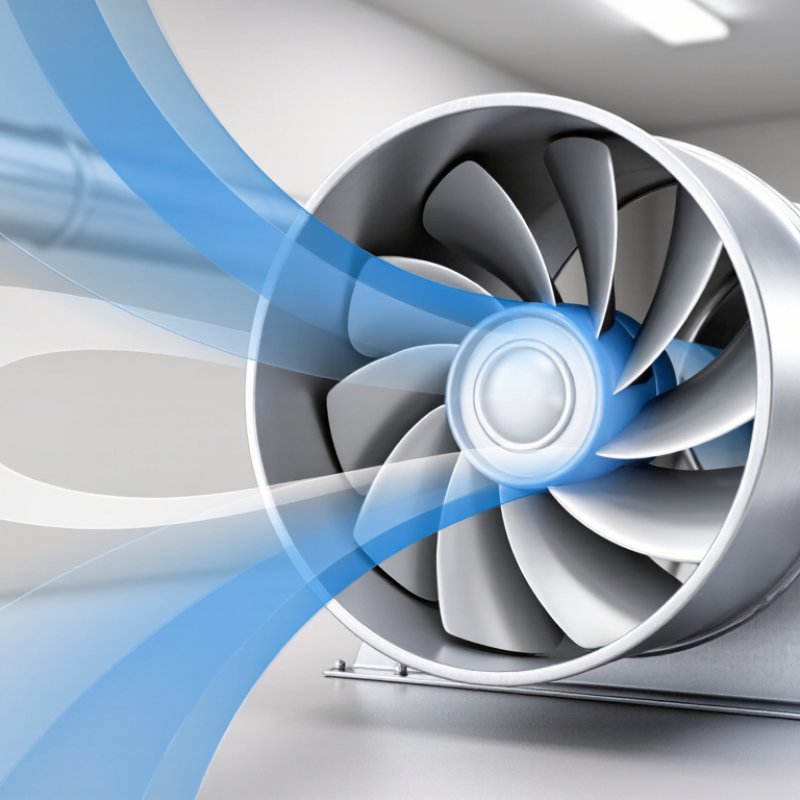
A centrifugal vent fan converts motor power into controlled air movement. Air enters through the central inlet and meets a rotating impeller, often called the wheel. The curved blades push air outward by centrifugal force. A spiral housing then collects that air and guides it toward the discharge opening. The housing shape matters. Poor fitting can create turbulence, noise, and avoidable pressure loss.

The motor supplies rotation through a shaft, direct drive, or belt system. Bearings keep the shaft aligned, while a robust frame limits vibration. Dampers regulate airflow, and filters remove particles before they reach the wheel. In practical inspections, clogged filters often cause more trouble than the fan itself. The details matter.

The IEA’s Energy Efficiency 2023 report states that electric motor systems consume about 53% of global electricity. This figure shows why motor selection and control deserve careful attention. U.S. Department of Energy fan-system guidance explains that a 10% speed reduction can reduce theoretical power demand by roughly 27%, when affinity-law conditions apply. Variable-speed controls can therefore match airflow to actual demand, rather than running continuously at full output. Still, the estimate is not perfect. Dirty ducts, sharp elbows, poor seals, and an incorrectly sized outlet can weaken those savings. AMCA testing practices also emphasize verified airflow, pressure, sound, and efficiency ratings, helping engineers compare performance under consistent conditions.

How a Centrifugal Vent Fan Moves and Pressurizes Air

A centrifugal vent fan moves air by changing its direction, rather than pulling it straight through. Air enters near the center of a rotating impeller. Curved blades catch the airflow and drive it outward. Centrifugal force creates velocity at the blade tips. The housing guides that fast air toward the discharge opening. This casing matters. Its widening passage converts some velocity into static pressure.

Static pressure helps the fan push air through duct bends, grilles, filters, and dampers. A bathroom fan may move moist air through a narrow duct, while an industrial unit handles longer runs. As the impeller spins, low pressure forms near the inlet. Room air follows the pressure difference into the fan. Air follows pressure. The process continues while the motor supplies torque. Higher speed usually increases airflow, but it also raises noise, energy use, and system pressure. Fan selection should match the duct system, not only the stated airflow.

Real systems are less tidy. Field technicians often find that crushed flex duct sharply reduces delivery. Loose joints can leak air into a ceiling void. A clean inlet and supported duct may improve performance more than expected. Measuring airflow and static pressure gives stronger evidence than judging motor noise. However, poor instrument placement can distort those readings. The fan may be powerful, yet the room remains damp because replacement air is missing. That overlooked detail deserves careful checking. A fan curve can reveal the actual operating point, though it cannot correct a badly installed system.

Key Fan Types, Drive Systems, and Performance Factors

A centrifugal vent fan moves air by changing its direction. Air enters the impeller near the center, then leaves radially through the housing. Curved blades add pressure and velocity. A scroll-shaped casing converts some velocity into useful static pressure. This design suits ductwork, filters, and long exhaust runs. In practice, a fan may sound quiet at the grille but louder near a restrictive elbow. Installation changes the result.

Forward-curved fans deliver high airflow at modest pressure, often in compact ventilation units. Backward-curved fans usually handle higher pressure with better efficiency. Radial-blade fans tolerate dusty air, although their efficiency may be lower. Direct-drive motors connect to the impeller, reducing parts and maintenance. Belt-drive systems allow speed adjustment and keep the motor away from warmer air. They also need tension checks and eventual belt replacement. A reliable selection matches the fan curve to system resistance, not just the advertised airflow.

Performance depends on airflow, static pressure, motor power, speed, temperature, and air density. A clogged filter can shift the operating point away from its rated value. Measure pressure across the system, then compare it with the fan curve. Listen for bearing noise, vibration, or unstable surging. I have found that small duct leaks can undermine careful calculations. Energy use matters, too. A speed controller can reduce power when demand falls, but poor commissioning may leave efficiency claims as assumptions.

Common Applications, Benefits, and Maintenance Considerations

A centrifugal vent fan uses a spinning impeller to move air through a housing. Air enters near the center, then moves outward under centrifugal force. The housing directs this airflow into a duct or discharge opening. Air moves outward. This design can handle longer ducts and higher resistance than many basic axial fans.

Common applications include bathrooms, kitchens, workshops, warehouses, and commercial exhaust systems. It helps remove humidity, cooking fumes, dust, and warm air from enclosed spaces. In a workshop, the fan may support localized extraction near a machine. In a bathroom, it can reduce moisture around mirrors, ceilings, and painted surfaces. Correct sizing matters. An oversized fan may waste energy and create unnecessary noise.

Maintenance is practical but easy to neglect. Inspect the impeller, grille, motor, and duct connections regularly. Dust on the blades can reduce airflow and increase vibration. Clean accessible parts with power disconnected, and follow the equipment’s service instructions. Check for loose fasteners, unusual sounds, and weak extraction. Noise matters. A qualified technician should examine electrical components and damaged ductwork. Keep records. In practice, no installation is perfect, so airflow should be checked after cleaning or duct changes. Local ventilation and electrical requirements also deserve attention, especially in damp or commercial areas.

Shopping Cart
Scroll to Top

Search for...

The Duravant family of operating companies serve the food processing, packaging and material handling segments.